
Required sensitivity, spectra, medium. Advice and guidance from our team.

Get your specific wavelength combination. Optimize for required dynamic range. Integrate into your system.

Acceptance/QC criteria. Certificate of analysis. Flexible volumes from <100 to <<1000 p.a..
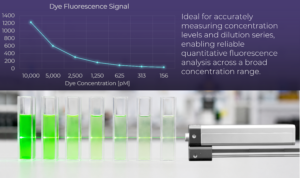
Precise measurement of concentrations and dilution series for accurate adjustment and quality control
The system is ideally suited for accurately measuring different concentration levels and dilution series, enabling reliable quantitative fluorescence analysis across a broad concentration range. The fluorescence intensity can be directly correlated with the concentration of the fluorescent target, allowing even small concentration differences to be distinguished.
This makes the setup particularly valuable for generating calibration curves, evaluating assay linearity, and determining concentration-dependent signal responses. Serial dilutions can be measured systematically to assess the dynamic range, sensitivity, and reproducibility of an assay.
Extending FluoSens to microfluidic fluorescence detection
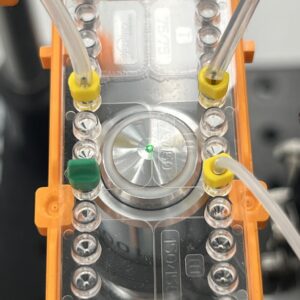
The feasibility study demonstrates that FluoSens can be successfully adapted for fluorescence detection in microfluidic systems, enabling reliable measurements directly within microchannels.
The FluoSens Go was equipped with a microscope objective to improve spatial resolution. The detector was positioned beneath a microfluidic chip and precisely focused on the channel through which the fluorescent beads were flowing. The flow rate was controlled using an external pump. By continuously monitoring the fluorescence signal, individual beads passing through the detection spot could be reliably detected and counted. By reducing the excitation spot size to 150 µm, the system successfully detected both dissolved fluorescent dyes and individual 10 µm fluorescent particles under continuous-flow conditions. Measurements showed stable signals and an excellent signal-to-background ratio.
Key demonstrated capabilities include dual-channel fluorescence detection, sampling rates up to 1,000 Hz, particle detection, and a compact architecture suitable for OEM integration. These results position FluoSens as a flexible detection platform for Lab-on-a-Chip systems, microfluidic analyzers, point-of-care diagnostics, and potentially flow-cytometry-related applications.
Oil and algae in water
A small mobile, handheld system (FluoSens Go plus cuvette holder) was used to check water quality and determine possible contamination in drinking water reservoirs. An oil-contaminated sample, an algal sample, and a water blank sample were measured, with the signal being recorded continuously.The black trace shows strong responses for both lubricator oil and algae: the response to algae is undoubtedly due to NADPH fluorescence, which is used routinely as a marker for aquatic biomass. Clearly this measurement is open to interference from oils and other aromatic hydrocarbon products. The additional use of the second channel, which is sensitive to generic algal chlorophylls, effectively differentiates algal fluorescence from fluorescence due to oils. The use of chlorophyll-specific wavelength sets may also be used to differentiate different algal types.
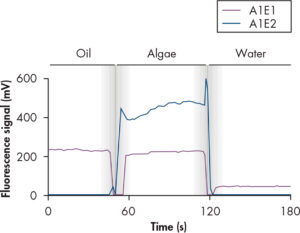
Effective differentiation of algal fluorescence from oils: The shaded regions represent sample changeover. The blue trace shows the signal optimized for algae (excitation 365 nm, emission 680 nm); the black trace shows the signal for excitation 365 nm, emission 460 nm.
Viable E. coli cell test
The resazurin system measures the toxic effects of unknown compounds by assessing the metabolic activity of living cells. Viable cells take up resazurin and reduce it internally to resorufin. This fluorescent compound and the reduction-oxidation reaction can be monitored. Only viable cells can reduce resazurin, therefore any change in fluorescence intensity is due to the presence of viable cells.A dilution series of Escherichia coli K12 cells was prepared, resazurin (Sigma- Aldrich) was added, and the experiment conducted according to the manufacturer’s instructions. Fluorescence was measured in a 1 cm quartz cuvette using the FluoSens Go with cuvette holder (excitation 550 nm, emission 600 nm). A total of 27 cells in a total volume of 300 μl were detected. Extrapolation of the data to the ± 3x standard deviation show that the limit of detection was around 15 cells in 300 μl and this sample can be distinguished from the blank (resazurin containing buffer without cells).
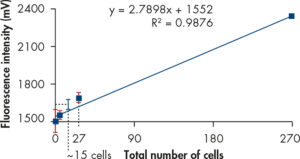
Efficient detection of viable cells. Error bars are shown in red. The blue error bar represents the extrapolated data of detectable cells. The total volume was 300 μl and a total of 27 cells in 300 μl were measured. A total of 15 cells in 300 μl can be detected (extrapolated).
Detecting oxygen levels in air
An oxygen sensor based on heavy metal chelates and a collisional oxygen quenching mechanism was used to determine the oxygen content in air using fluorescence. The FluoSens Go was used to excite the oxygen sensor and detect light emitted by it. The response of the signal is very fast (in the milli second range) and is reversible.
Photo: Fast and reversible signal response. The oxygen sensor was exposed to different oxygen concentrations at different time points.
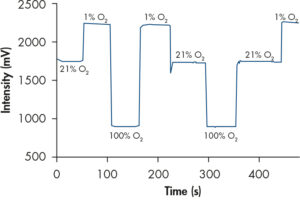
Fast and reversible signal response. The oxygen sensor was exposed to different oxygen concentrations at different time points.
FluoSens in scientific applications
FluoSens technology was originally developed in Stockach and commercialized first by QIAGEN and later by DIALUNOX. In July 2025, Dermagnostix acquired FluoSens technology, including the associated production assets, expertise, and intellectual property rights. Today, FluoSens is further developed and marketed under the brand Lumalytix – powered by Dermagnostix.
This review highlights more than a decade of peer-reviewed research demonstrating the use of FluoSens fluorescence detector technology across a broad range of scientific applications. Published studies have integrated FluoSens into platforms using:
- PCR/qPCR
- RT-PCR
- LAMP
- NASBA
- RPA
- Non-enzymatic amplification
- Diverse OEM and microfluidic architectures
The documented applications extend from molecular diagnostics and fluorescence-based process control to environmental monitoring and biosensing. Collectively, the evidence demonstrates the versatility of FluoSens as a compact optical detection technology that can be adapted to different assay formats, system architectures, fluorophores, and measurement requirements.